Pavilions, pitches and practice nets
Follow the documented development of Langleybury’s pavilions and playing facilities from the early 1950s to the 2019 assessment.
The surviving building history is a sequence of dated observations, recollections and proposals. It explains how the cricket facilities developed while also showing where precise construction dates remain unknown.
The first wooden pavilion
The club’s 1988 retrospective associates a wooden pavilion with 1952 and says it subsequently burned down. The account does not date the fire. It would be wrong to supply a date from the history of nearby Abbots Langley Cricket Club, which is a different organisation. The programme’s ground history.
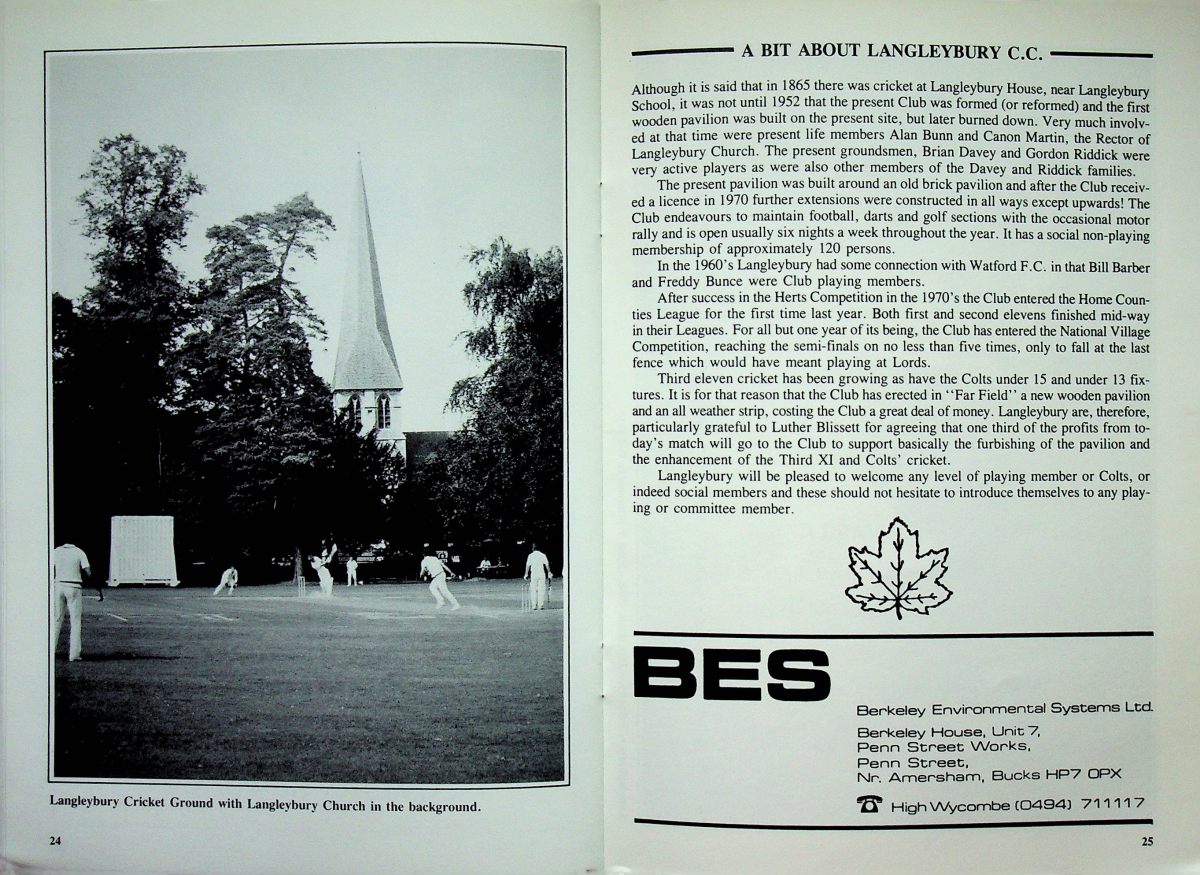
The same history says the later pavilion incorporated an older brick structure. A licence obtained in 1970 preceded further extensions, but the source does not establish the licence’s precise terms or identify every phase of building work.
Far Field in 1988
By July 1988, the programme described a new wooden pavilion and an all-weather strip in Far Field, serving third-XI and Colts cricket. The distinction is useful: the club’s ground development supported more than its leading side. The exact construction date and the relationship to later second-ground buildings are not established. 1988 programme.
Funding was part of that story. One third of the profits from the advertised 15 July testimonial match was earmarked for pavilion furnishings and youth and third-XI development. That is the programme’s planned allocation, not an audited account of the final proceeds. Read more about the programme.
Improvements recorded in the 2000s
The July 2005 Three Rivers sports assessment described two pitches, the junior pitch then having an artificial wicket, and nets improved before that season. It also recorded plans for clubhouse refurbishment after the season, covering changing, catering and access. The assessment proves the plan was recorded; it does not prove when all of that work was completed. 2005 assessment, outdoor sports section.
In January 2011, Councillor Chris Hayward allocated £1,000 towards nets work. The reported work included repositioning to allow proper run-ups and improvements to the practice surface. The grant report provides a specific investment story without requiring a guessed construction timetable. Contemporary grant report.
The Norman Chase pavilion
Norman Harold Chase’s obituary in July 2015 says the pavilion had been named in his honour. It identifies him as club president from 1998 to 2015, after earlier involvement as a supporter and vice-president. The naming date has not been recovered. Chase’s obituary.
The pavilion’s name records a form of contribution not captured by batting and bowling tables. Chase’s profile covers his connection with the club and the distinction between the naming and the years of his presidency.
The 2019 assessment
The February 2019 Playing Pitch Strategy Assessment Report recorded grass squares with 12 and eight wickets, plus a non-turf wicket on the second site. It rated both grass squares and changing facilities as good, noted fixed nets and attributed improved ground quality to a dedicated groundsman. The retrieved passage does not name that groundsman. 2019 assessment, printed pages 53–58.
These findings are historical observations from 2019, not a present-day facilities inspection. Together with the older accounts, they demonstrate how much of the club’s development depended on practical work at the ground.
Sources and further reading
- 1988 programme, printed pages 24–25: ground photograph and club history — checked 2026-11-02
- Three Rivers Open Space, Sport and Recreation Study — checked 2026-11-02
- Watford Observer: Chris Hayward locality grant for Langleybury CC, 6 January 2011 — checked 2026-11-02
- Courageous WW2 pilot and president of Langleybury Cricket Club for 17 years dies aged 94 — checked 2026-11-02
- Three Rivers Playing Pitch Strategy Assessment Report — checked 2026-11-02